
What cocorev can help you achieve
A partner connection gives your team visibility into where customers, prospects and opportunities overlap. The value comes from using that visibility to create better seller collaboration.
- Generate opportunities. A partner helps turn a relevant lead into an active sales opportunity.
- Progress active deals. A partner provides intelligence, influence or an introduction that helps move an opportunity forward.
- Find expansion potential. Both teams identify shared customers or accounts where another team, department or geography may benefit.
- Build a AE network. Your AEs develop relationships with people in the same ecosystem who can share context, support deals and create future routes into accounts.
The main commercial outcomes are:
- Sourced opportunity: A partner turns uncovers lead into an opportunity.
- Influenced opportunity: A partner provides relevant intelligence, influence or an introduction that helps progress an existing deal.
These outcomes may take time to appear, so the earlier stages of collaboration should also be measured.
Useful early milestones include:
- Relevant accounts reviewed
- Useful account context exchanged
- Information passed to the appropriate AE
- Seller-to-seller messages or working calls
- Influence or introductions provided
- Successes and learnings documented for a wider rollout
The five principles of good collaboration
|
Principle |
What it means in practice |
|---|---|
|
Start small |
Pilot with a small number of accounts before involving the wider sales team. |
|
Give to get |
Share useful context first. People help faster when they can see the relationship will work both ways. |
|
Move incrementally |
Start with intelligence, build towards influence, and only then ask for an introduction where it makes sense. |
|
Use the intel, do not repeat |
Use partner information to prepare and make better decisions. Do not reveal, repeat or attribute it to the customer. |
|
Make every ask specific |
Explain the account, the situation and the help you need. Avoid sending a list of names with no context. |
|
Professional collaboration etiquette Partner information should make your preparation and messaging more relevant. It should never become something you reveal to the customer or use to expose the partner relationship. |
Before you start: Set up a controlled HubSpot view
During the pilot, the cocorev Partner Summary should be visible to the people who have been briefed on how to use it, rather than appearing unexpectedly across every company record.
Recommended setup:
-
Clone the default HubSpot company record view.
-
Add the cocorev Partner Summary card to the cloned view.
-
Create a small cocorev pilot team containing the cocorev administrator or activation owner first. Then you will add relevant AEs as you roll out the pilot.
-
Assign the cloned view to that cocorev pilot team so the wider sales organisation don't see the cocorev app card.
-
It creates a clear pilot group and prevents other AEs from seeing partner context before they understand how it should be used.
After the pilot, choose the rollout that best fits the team. You can add the wider sales team to the cocorev view, or add the cocorev card to the default view once the working principles and process are understood.
1. Explore the four plays
Once you are connected to at least one partner, cocorev organises the available overlap into four practical plays. Open each one before choosing where to start.
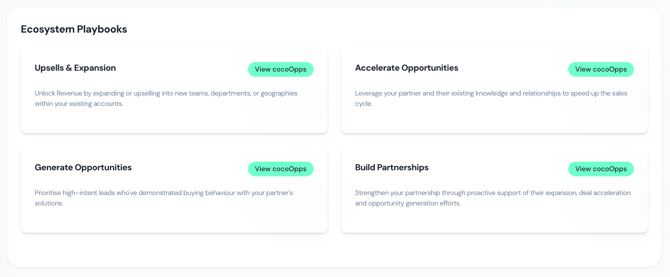
The four cocorev plays on the home screen.
- Upsells & Expansion: Find ways to expand within existing accounts.
- Accelerate Opportunities: Use partner knowledge and relationships to help progress active deals.
- Generate Opportunities: Identify relevant leads connected to a partner’s customers or opportunities.
- Build Partnerships: Look for ways to help the partner with their own pipeline and expansion efforts.
There is no single best play for every connection. Start where you find the strongest combination of relevant accounts, engaged sellers and a clear reason to collaborate.
2. Shortlist a small number of accountsA partnerships or sales leader should review the overlap before involving the wider team.
Open each play and identify three to five accounts with the clearest reason to collaborate. The shortlist is simply the initial working set for the pilot.
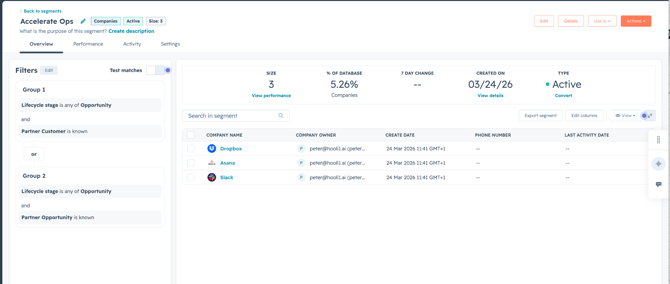
Each play opens a HubSpot segment containing accounts that can be worked with a partner.
3. Review the available contextBefore arranging any seller calls, the activation owner should review the information already available for each shortlisted account.
This may include:
- The current lifecycle or opportunity stage
- Recent activity
- Known stakeholders
- Existing notes
- Current projects or priorities
- Previous conversations
- Procurement steps or potential blockers
- The next planned action
The Pilot Lead should identify the context that could appropriately help the other company make a better decision or have a more relevant conversation.
4. Identify the seller's involved
Open an account record in HubSpot. The cocorev Partner Summary shows which partner can help, the relationship stage and the account owner in the partner organisation. Their email address is provided so the right sellers can be connected directly.
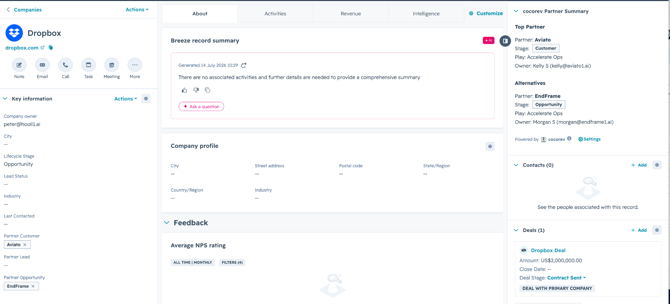
The cocorev Partner Summary shows the relevant partner and account owner on the HubSpot company record.
The pilot lead should introduce the two AEs rather than asking sellers to contact unfamiliar partner reps without context.
5. Connect the sellers- Confirm that the internal AE is happy to collaborate on the deal. This may require context of the bigger play and why this is important that they collaborate.
- Introduce the internal AE to the relevant partner AE.
- Name the initial accounts and explain that the goal is to compare useful context, not immediately request introductions.
- Ask the AEs to arrange a short working call and join the first call to help it along if required.
- Stay involved during the pilot and review what happens before expanding the programme.
The strongest seller relationships begin with useful context. Before asking the partner AE for anything, explain where you are and what you have learned.
Share what is relevant, including:
- The current opportunity stage
- What has already been learned
- The stakeholders involved
- Any obstacles or unanswered questions
- The next planned action
- Anything that may help the partner’s own relationship with the account
|
Why would another seller help? Because they believe the relationship may help them too. Prove that early by sharing useful context, supporting one of their accounts or making their job easier. |
Not every overlap should lead immediately to a warm introduction. There are three levels of collaboration, and each one builds trust for the next.
1. Intelligence
Ask for information that helps you make better decisions and have a more relevant conversation.
- Are there any projects or priorities we should understand?
- Which outcomes or metrics matter most to the customer?
- Are there important stakeholders we should know about?
- Are there any procurement steps or potential blockers we should prepare for?
2. Influence
Once the relationship has some trust, ask whether the partner can reinforce your relevance in a future customer conversation.
- Would you be comfortable mentioning our solution the next time you speak with them?
- Could you reinforce why this is relevant to the project they are working on?
3. Introduction
Ask for an introduction only when there is a clear reason, the timing is right and the partner can make it credibly.
- Explain why the introduction is useful to the customer.
- Name the right person and the relevant context.
- Provide a short introduction blurb the partner can edit or forward.
|
The rule Intelligence and influence can be just as valuable as an introduction. Do not treat the introduction as the default first request. |
Information shared through cocorev should help you prepare, prioritise and make your conversations more relevant. It should not be repeated, attributed or revealed to the customer.
|
Do |
Do not |
|
Use what you learn to prepare better questions, anticipate concerns and shape a more relevant approach. |
Tell the customer that you know they are a partner customer or repeat private information that the partner shared. |
When in doubt, ask the partner AE what can be referenced externally.
Run the first AE callA simple first call can follow this agenda:
- Share the current position on each account.
- Compare useful context and confirm what can be referenced externally.
- Decide whether the next action is intelligence, influence or an introduction.
- Look for at least one way to help the partner AE in return.
- Assign an owner and next step for each selected account.
After one or two weeks, review the pilot with the participating AEs.
- Did useful intelligence change the approach?
- Did a partner influence or introduction help progress a deal?
- Was a new opportunity created?
- Did both sellers receive value?
- Should the process be repeated with more accounts or AEs?
Only expand when the first group understands the working principles and has demonstrated useful collaboration.
Roll out to the wider team
When the pilot is working, choose the setup that best fits the organisation.
You may:
- Run a training session using the successful pilot as the example
- Add more sellers to the dedicated cocorev view
- Add the relevant sales team to the cocorev pilot team
- Add the cocorev Partner Summary to the default company view
Wider access should only be provided once the team understands:
- The give-to-get mindset
- The Intel → Influence → Introduction process
- How to make specific requests
- How to use partner information without revealing it to the customer
The goal is bigger than a single introduction. It is to build a personal ecosystem of sellers who share useful intelligence, support each other’s opportunities and create new routes into accounts.
AI can help process information and improve messaging. It cannot replicate the trust and influence of a network built by helping other people succeed.